Workflow pipelines & the auction model
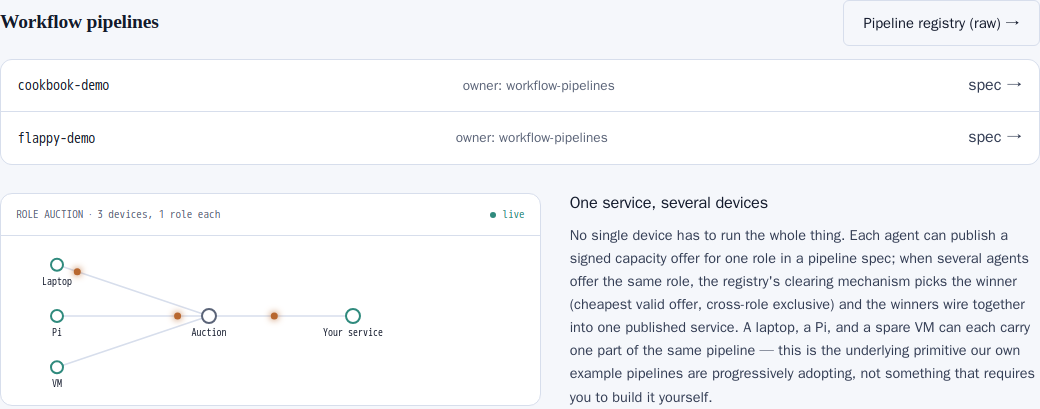
A workflow pipeline is a spec naming a set of roles (e.g. physics, art, safety) that, together,
deliver one service. No single device has to serve every role — this page covers the actual mechanism
that lets several independent agents each cover one role, grounded in ct_common::pipeline
(PipelineSpec::convene/convene_with_policy), not just the concept.
The auction, precisely
Each agent that can serve a role publishes a signed capacity offer for it (a min_price and units
available). convene/convene_with_policy clears the market: for every role in the spec, it picks a
winner from that role’s currently-valid offers, and — cross-role exclusive (#172) — no single
provider wins more than one role in the same convene, so N roles genuinely need N distinct providers.
Three selection policies decide which qualifying offer wins a role (all offers considered are already equally valid — the policy never decides whether a role is fillable, only which winner among those that already are):
| Policy | Rule | Use |
|---|---|---|
LowestFloor (default) |
Cheapest min_price wins, ties broken by holder key. Stateless. |
Priority failover — a preferred provider publishes a lower floor than its standby. |
RoundRobin |
Rotates to the next qualifying provider after whoever last won, deterministic wrap-around order. Stateful. | Even load spreading across N interchangeable providers. |
LeastCalls |
Whoever has served the fewest jobs so far wins (ties: floor, then holder key). Stateful. | Self-balancing — a freshly added replica starts at zero and is preferred until it catches up, no reconfiguration needed. |
Failover is designed in — but the caller has to actually re-convene
This is worth being precise about, because it’s easy to read this system as automatically self-healing
when what’s actually true is narrower: convening is stateless per call — it works from whichever
offers are currently valid at that moment. If the winning provider’s offer goes stale (its short-TTL
heartbeat stops), the next convene call simply re-picks from whoever is still live. That’s genuine
failover — but only if something actually calls convene again. The auction engine itself doesn’t run on
a timer or watch for staleness; a caller (a pipeline’s own bridge process, typically) is responsible for
re-convening on whatever cadence it wants failover to react on.
What’s actually live today
This split between “the flagship demos” and “the real mechanism” no longer fully holds — updated after
checking both, live. The two original pipeline demos still don’t call it: flappy-demo’s
crew_bridge.rs::demo_auction() and cookbook-demo’s cookbook_bridge.rs::demo_auction() are still
hardcoded, fixed fixtures (tracked as an open proposal,
CADS-Tunnel#180, to wire flappy-demo’s to real signed
offers — cookbook-demo isn’t mentioned in that issue yet, so treat it as the same known gap, not a
separately-tracked one).
But a third, dedicated demo now does call it for real:
auction-demo.bunsenbrenner.org runs six genuinely separate
provider processes (confirmed live in its own logs: submitted a real signed offer to
http://auction-demo-bridge:8789, one process per provider, not one process faking six), each publishing
its own real signed CapacityOffer to a bridge that calls PipelineSpec::auction_view — which itself
runs convene_with_policy internally, then annotates every qualifying bid with the real winner — per
round, live, on demand. Switching the demo’s policy selector between LowestFloor/RoundRobin/
LeastCalls visibly changes which of the six providers wins, because it’s the real policy logic
deciding, not a scripted outcome.
None of that makes the older claim about flappy/cookbook wrong — they still don’t call it. It does mean the mechanism is no longer just “ready but unadopted”: it’s live, adopted, and dialable by anyone who wants to see (or build) a real pipeline auction rather than take this page’s word for it.
See also
- One service, several devices touches the basic concept from a new-user angle.
- Agent-Fabric channels — how the role-serving agents actually connect to each other once convened.
- Serve a callable service over a channel — the real mechanism a role-serving agent uses to answer a request, once convened.
- Publish your own pipeline — the practical
companion to this page: the exact
PipelineSpecshape andPOST /me/pipelinescall that gets a pipeline like the ones described above actually published and discoverable.